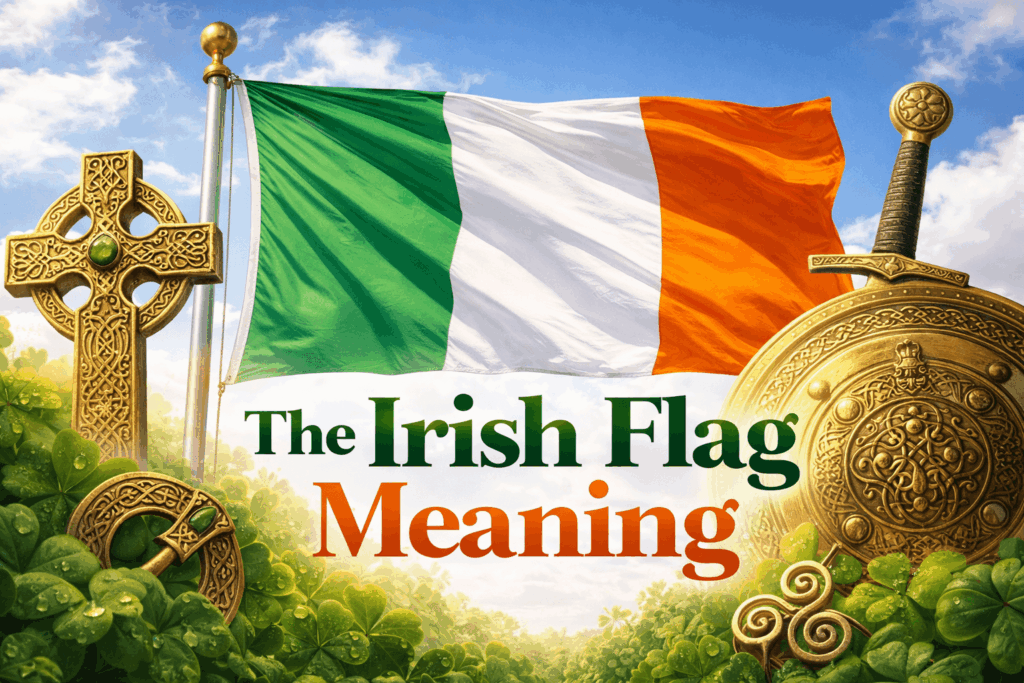

With its bold three vertical bands of green, white, and orange, the Irish flag is one of the world’s most recognisable symbols, flying high at St. Patrick’s Day parades, outside your favourite Irish pub, and GAA clubs across the U.S., Canada, and Australia. The Irish flag is full of meaning, also known as “The Tricolour“, it represents Ireland’s patriotism, cultural identity, and a vision for peace.
In this article, we’ll uncover the meaning of the Irish flag, its hidden symbolism, and some fun facts, including a few that we bet you didn’t know!
But before we explore the fascinating history and meaning of the Irish flag, here’s a fun challenge – Ireland is one of just four countries in the world to feature orange in its national flag. Can you guess the other three? Keep reading, you’ll discover the answer at the end!
The Meaning of the Irish Flag
The colours of the Irish flag carry deep symbolic meaning, reflecting both religion and politics. When Thomas Francis Meagher introduced the tricolour in 1848, he explained the meaning of the Green, White, and Orange colours.
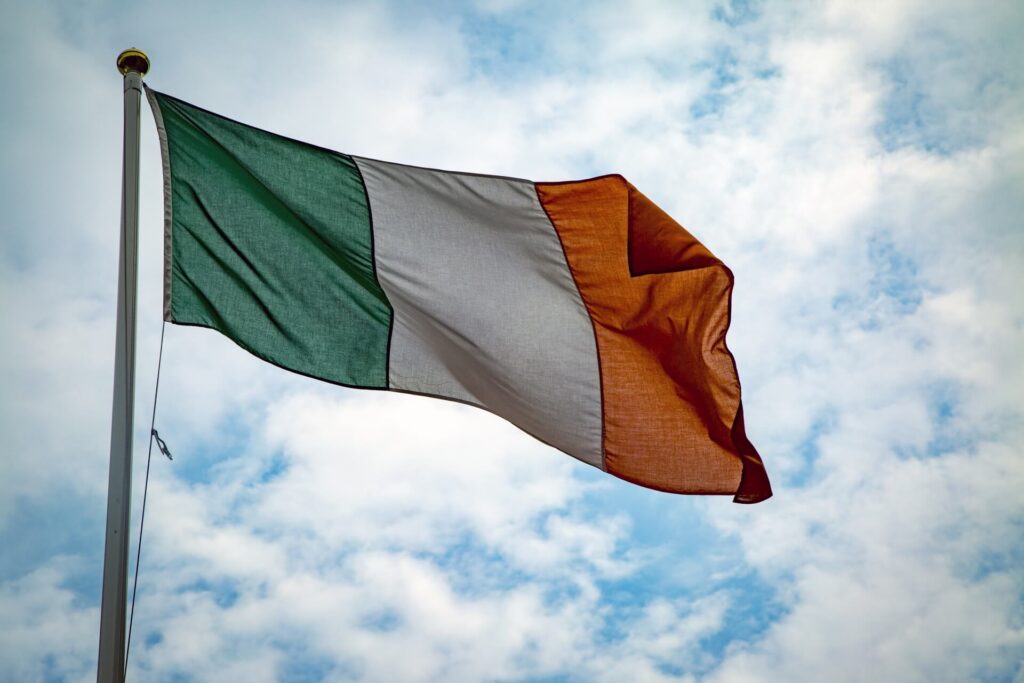
Green represents Ireland’s Catholic population and the tradition of Irish nationalism, while orange represents the Protestant community, particularly those associated with William of Orange. The white stripe placed between the two communities symbolises peace and hope for reconciliation.
At a time when Ireland was deeply divided along religious and political lines, the Irish flag presented a powerful and progressive idea: unity rather than dominance. The colour green, long associated with the Catholic and nationalist tradition, has since evolved beyond its original meaning. Today, green symbolises Irish culture, the country’s lush landscapes, and a shared sense of national pride. The green colour is proudly worn on Irish rugby and soccer jerseys, Olympic athletes representing Ireland, and seen illuminating iconic landmarks each year during St. Patrick’s Day celebrations.
Meanwhile, orange continues to reflect Protestant heritage, especially in Ulster. Every year on July 12th, this history is celebrated across Northern Ireland, when parades fill the streets and orange is the dominant colour, commemorating William of Orange’s victory at the Battle of the Boyne in 1690, a turning point that secured Protestant influence in Ireland and Britain.
The History of the Irish Flag
The history of the Irish tricolour flag dates back to 1848, a year marked by revolutionary uprisings across Europe. In countries such as France, Italy, and Germany, nationalist movements rose up to challenge monarchies and demand political reform. It was during this turbulent period that the idea of an Irish tricolour first emerged.
Thomas Francis Meagher, an Irish nationalist and leading figure of the Young Irelanders, played a central role in the history of the Irish flag. While in Paris during the 1848 French Revolution, Meagher was inspired by the French tricolour, a powerful symbol of liberty, equality, and national unity.
He adopted this concept and brought it back to Ireland, proposing a green, white, and orange flag as a visual representation of reconciliation between Ireland’s divided communities. This moment marked the beginning of the Irish tricolour’s journey as one of the most important symbols of Irish identity and nationalism.
Later that year, Meagher displayed the Tricolour flag publicly in Waterford, describing it as a symbol of unity between Ireland’s Catholic and Protestant communities. This was just a few years after the Great Famine, when political tensions and resentment toward British rule were extremely high.
Despite its meaningful symbolism, the tricolour did not immediately replace older Irish flags. It was not until the Easter Rising of 1916 that the tricolour gained widespread recognition as Ireland’s national flag. During the rebellion, the Irish flag was raised above Dublin’s General Post Office by Gearóid O’Sullivan, from that moment on the tricolour came to represent the Irish nation.
While reading about the Irish flag is fascinating, seeing the sites that shaped its history makes it even more real.
- Book a tour of the General Post Office, Dublin – Stand where the tricolour first flew in 1916.
- Stay at the Shelbourne Hotel, Dublin – Experience the history of the city at one of its iconic hotels.
An Irish Patriot
Thomas Francis Meagher was one of the most remarkable and colourful figures in Irish history. An Irish nationalist and revolutionary, he was sentenced to death by the British authorities for his role in the 1848 Young Ireland Rebellion. The sentence was later commuted to life imprisonment, and Meagher was transported to Van Diemen’s Land, present-day Tasmania.
In a dramatic turn of events, Meagher escaped his exile and fled to the United States, where his story took on an entirely new chapter. During the American Civil War, he joined the Union Army and rose through the ranks to become a brigadier general, famously leading the Irish Brigade.
His extraordinary life, spanning rebellion, exile, escape, and military leadership, cemented Meagher’s legacy as a key figure in Irish nationalism and a symbol of Irish influence abroad.
How the Irish Tricolour Became the National Flag
The Easter Rising of 1916 marked the tricolour’s defining moment. Irish rebels raised the green, white, and orange flag above the General Post Office in Dublin, linking it forever to the struggle for independence. After the Rising, the flag became closely associated with republican movements. During the War of Independence (1919–1921), it was widely used by Irish forces and supporters of self-government.
Following the establishment of the Irish Free State in 1922, the tricolour functioned as the de facto national flag, even though it wasn’t yet formally enshrined in law. Official recognition came in 1937, when the Constitution of Ireland declared:
“The national flag of Ireland is the tricolour of green, white and orange.”
What had begun as a symbol of unity during rebellion became the official emblem of a sovereign state.
✈️ Touch down in Dublin and start exploring instantly – no stress, all sights – Dublin Airport Transfer and Hop-On Hop-Off Bus Ticket
The Green Harp Flag
Contrary to popular belief, Ireland’s original national colour was blue, not green. Long before the Irish tricolour existed, Ireland was represented by the Blue Harp Flag, which featured a gold harp on a blue background known as St. Patrick’s blue. In fact, St. Patrick himself was historically associated with blue rather than green. The Blue Harp Flag was used to represent the Kingdom of Ireland under English rule.
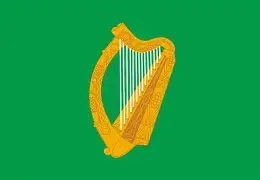
By the 17th and 18th centuries, green gradually replaced blue as the colour most closely linked with Ireland. It became especially popular among Catholic and nationalist communities, where green came to symbolise Ireland and resistance to British rule.
Nationalist movements continued to use the harp as a central symbol but placed it on a green background instead of St. Patrick’s blue. This Irish flag became known as the Green Harp Flag and emerged as a powerful emblem of Irish nationalism. It also directly influenced the green stripe of the modern Irish tricolour.
The Irish harp itself is one of the oldest national symbols in Europe, dating back to at least the 8th century, where it appeared on stone crosses and illuminated manuscripts. Over time, the harp became a symbol of Irish identity and sovereignty. Today, the harp still appears on official state symbols, including the Presidential Standard and government seals.
Another cool fact about the Irish harp is its direction. On official Irish state symbols, the harp faces left, while on the Guinness logo, it faces right. This difference is because Guinness registered its harp design first, and the Irish government reversed the harp’s orientation on official emblems to avoid copyright issues.
Flags tell powerful stories – Find out the history and meaning of the Greatest Country Flags of the World here.
Significant Irish Rebel Songs
During British rule in Ireland, Irish flags such as the Green Harp Flag and later the Irish tricolour were often illegal or effectively suppressed, especially during periods of unrest or rebellion. Despite this repression, these Irish symbols endured, proving that Irish flags were never just decorative. They represented political resistance, cultural identity, and resilience in the face of suppression.
This symbolism is particularly evident in Irish rebel music. A well-known example is “The Wearing of the Green”, a song that celebrates Irish nationalism and the enduring importance of green as a symbol of Ireland.
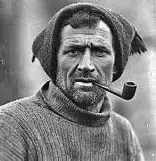
The wearing of the green was also known to be one of explorer Tom Crean’s favourite songs, and in our opinion, must have given him strength and resilience during his epic Antarctic adventures.
Similar themes can also be found in well-known Irish rebel songs such as “Skibbereen” and “The Rising of the Moon.” These ballads highlight how the colour green, Irish flags, and music became powerful symbols of Irish identity, resistance, and the ongoing call for national freedom.
Remember… Which countries have orange in their flag? Scroll to the bottom to find out!
Ireland’s Must-See Day Trips from Dublin
🔥 Giant’s Causeway, Dunluce Castle & Dark Hedges – Explore the legendary Giant’s Causeway, stroll through the mysterious Dark Hedges, and visit the dramatic Dunluce Castle. This is one of Ireland’s best tours. Book your full-day adventure now!
🔥Cliffs of Moher & Galway Burren – Stand at the edge of the breathtaking Cliffs of Moher, then discover the unique Galway Burren landscapes, filled with stunning limestone formations. A must-see for anyone wanting to experience Ireland’s natural beauty and coastal wonders. Book your full-day Irish adventure before it sells out!”
🔥Blarney Castle, Cahir Castle & Rock of Cashel – Kiss the famous Blarney Stone at Blarney Castle, explore the medieval Cahir Castle, and marvel at the historic Rock of Cashel, one of Ireland’s top heritage attractions. Don’t wait, grab your tickets now on this popular day trip from Dublin.
Limited spots available – One click and you’re on your way to unforgettable Irish memories!
Orange in Other National Flags
While the Irish flag is famous for its green, white, and orange, only a few other countries feature orange in their national flags: India, the Ivory Coast, and Niger, all of which coincidentally also feature the colours green and white.
Each nation assigns a different meaning to the colour. In India, orange (or saffron) represents courage and sacrifice. The Ivory Coast uses orange to symbolise its land and savannahs, while Niger associates it with the northern desert regions. The national flags of India and Niger both display horizontal bands of orange, white, and green, with a unique symbol in the central white stripe.
The Ivory Coast flag is especially striking because it mirrors Ireland’s flag, but in reverse. This similarity led to a memorable sporting moment: after winning gold at the 2018 World Indoor Championships, Ivorian sprinter Murielle Ahouré couldn’t find her national flag.
She cleverly flipped an Irish flag given by a spectator and celebrated with it, turning a simple mix-up into a moment of international recognition.

Frequently Asked Questions About the Irish Flag
Why doesn’t Northern Ireland officially use the Irish tricolour?
As part of the United Kingdom, Northern Ireland flies the Union Jack Flag for official purposes. The Irish tricolour is strongly associated with Irish nationalism and republicanism, making its display politically sensitive in some parts of Northern Ireland’s divided communities.
What do the colours of the Irish flag mean?
The green stripe represents Ireland’s Gaelic heritage and Catholic community, white symbolises hope for peace and unity, and orange reflects the Protestant tradition, especially those connected to William of Orange.
How is the Irish flag different from the Ivory Coast flag?
Although both flags feature green, white, and orange vertical stripes, the order is reversed. Ireland’s flag has green at the hoist, while the Ivory Coast flag has orange at the hoist, making them easy to tell apart.
Which countries use orange in their national flags?
Besides Ireland, only India, the Ivory Coast, and Niger feature orange in their flags. Each country assigns a unique meaning to the colour, reflecting culture, history, or geography.
What is the Irish flag called in the Irish language?
In Irish, the flag is called “Bratach na hÉireann” (pronounced bra-tock na hair-inn). It’s also known as “an trídhathach”, meaning “the tricolour”.
We hope you enjoyed this article and now understand the history and meaning of the Irish flag. From government buildings and sports stadiums to St Patrick’s Day celebrations in Dublin, the Irish flag continues to tell a story centuries in the making – Pride, complex, and inspiring.

This post contains affiliate links. If you click on the links to make a purchase, we will earn a small commission. This is at NO EXTRA COST to you. This is a free way to support us and allow us to continue to create inspiring adventure travel guides.